
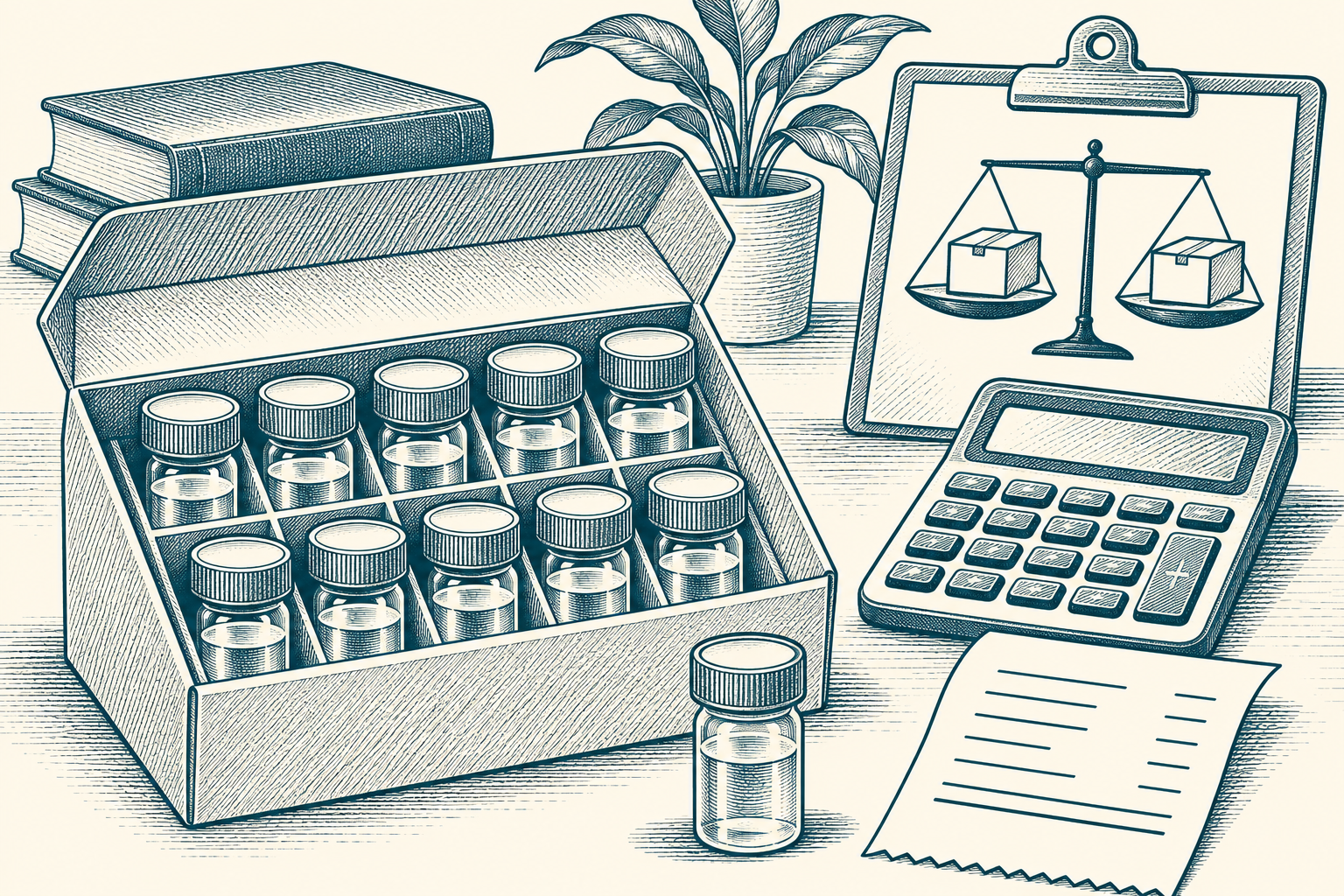
A ten-vial research peptide kit can have a lower price per vial while still requiring a bigger purchase than your laboratory needs. To decide whether it saves money, compare the same material, labeled quantity, and delivered cost. Then check whether the entire pack belongs in your purchasing plan.
The kit label is only a starting point. Some listings describe ten identical vials, while others offer a configurable bundle. The amount printed in a product title may refer to each vial or to the whole pack. Read those details before dividing any price.
Start with an equivalent item

Write down the material name, labeled mass per vial, number of vials, and product format. A ten-vial pack is comparable with ten single vials only when those specifications line up. A similar photograph or a familiar product name does not establish that the quantities are equivalent.
Keep single-material packs separate from mixed bundles. A bundle containing different materials may suit a particular purchasing list, but its average price per vial does not tell you the price of each component. Ask for a clear item breakdown when the listing leaves that uncertain.
Use the delivered total
Divide the final amount paid for the kit by the number of included vials to calculate its average delivered cost per vial. For the single-vial alternative, put the same number of equivalent vials in the cart and check that delivered total too. Use the same destination and shipping service.
Include shipping, taxes, and mandatory fees when they apply. Keep optional extras separate so you can see whether they changed the comparison. A low advertised kit price may be less competitive once delivery charges appear, while a larger order may qualify for a different shipping rate.
Example: kit price versus ten singles
Example: Imagine a fictional ten-vial kit with a delivered total of $200. Its average delivered cost is $20 per vial. Ten equivalent singles with a delivered total of $300 average $30 per vial. In this example, the kit saves $100 when your laboratory actually needs all ten vials.
Those round numbers are invented for explanation, not current vendor prices. If your purchasing list calls for only a few vials, the kit still requires the full larger payment. A lower unit price and a lower total purchase cost are different questions, so record both before deciding.
Check the labeled mass across the pack
For price-per-milligram comparisons, use the total labeled mass across every included vial. Do not divide the kit price by the amount in just one vial. Keep the pack count visible in your notes so the calculation can be checked later.
This is catalog comparison math, not confirmation of measured content. The label states the offered quantity; an appropriate quantitative analysis is separate documentation. Do not treat a chromatographic percentage as a direct measurement of the total mass in the kit.
Confirm which discounts apply
Add the exact kit to the vendor cart before assuming a coupon applies. A supplier may treat packs differently from singles, or a code may replace an automatic offer. Check the line items and final total after entering PEPDEALS rather than assuming a fixed percentage or combination.
Compare the cart with and without the code when an automatic discount is already present. Save the version that produces the lower delivered total for the same items. If the promotion adds store credit, record that credit separately from the amount payable now and read its redemption conditions.
Do not count unwanted extras as savings
A free item can lower an average cost on paper, but it does not necessarily reduce the cost of the materials on your laboratory’s purchasing list. Keep the required items and optional extras in separate columns. That prevents a bigger bundle from winning simply because it contains more containers.
Also distinguish a real reduction in spending from a future purchasing assumption. Buying extra stock may be reasonable when it is already budgeted and required, but a theoretical future need is not the same as an existing order requirement. Use your laboratory’s own inventory planning process.
Keep documentation consistent across the kit
Vendors on PepDiscounts have an independent COA naming the vendor and a lot number. For the specific kit being considered, ask which lot or lots will ship and which reports apply. Do not assume every vial in a pack shares one lot unless the supplier documents that.
If the kit contains more than one lot, keep the relevant report for each. Confirm that the invoice and delivered labels make the pack contents identifiable. For broader supplier questions, see the PepDiscounts vendor verification guide rather than treating the kit discount as a substitute for documentation.
Check storage and order policies before buying more
A larger pack needs a suitable place in your laboratory’s inventory system. Review the supplier’s written storage information for the exact material and format before committing to extra stock. Do not assume a general storage statement applies to every product or package.
Read the order policy for missing, incorrect, or damaged items too. Find out whether a kit is treated as one purchase unit and what information is needed to report a discrepancy. Save the listing and confirmation so the expected pack count is documented.
Find current kit and single-vial listings
The BPC-157 price page and G3R price page are places to compare changing listings without relying on a fixed price in an article. Match the labeled size and pack count before comparing the displayed figures.
Use the cheapest peptide cart to explore the purchasing list, then confirm each vendor’s final checkout total. Keep one note for the delivered cost and another for documentation. The most useful comparison is an equivalent order that meets your laboratory’s requirements.
FAQ
Is a ten-vial kit always cheaper than singles?
No. Compare the current delivered totals for equivalent quantities. Shipping charges, coupon exclusions, and automatic discounts can change the outcome. The word kit does not guarantee a lower cost.
Should I compare price per vial or price per milligram?
Use both when labeled sizes differ. Price per vial helps compare equivalent containers, while price per milligram helps normalize different labeled masses. Keep the complete pack total visible alongside either calculation.
What if I do not need every vial in the kit?
Compare the actual cost of the quantity required by your laboratory with the full kit payment. Do not count surplus stock as an automatic saving. Check inventory capacity and written storage information before purchasing a larger pack.
Research use only. Not for human or animal consumption. PepDiscounts doesn’t sell products or give dosing or medical advice, and may earn a commission through vendor links.
🛒 Buying more than one vial? Check out the Cheapest Cart tool and see where you can save the most money based on current sales, BOGOs, bulk discounts, coupon codes and shipping.

Leave a Reply